|
Germany's Eastern Front Allies (1)
(Men-at-Arms 131)
ISBN 0-85045-475-1
First Edition 1982
Collaborated with Peter Abbott.
The Finnish, Hungarian, Romanian, Slovak, Italian and Croatian forces fighting with the Germans on the Eastern Front. Forty photographs. Eight colour-plates by Mike Chappell. Map and plates of Finnish, Hungarian, Romanian and Slovak Army rank insignia by Peter Abbott.
Buy the book |
 |
Partisan Warfare 1941-45
(Men-at-Arms 142)
ISBN 0-85045-513-8
First Edition 1983
Collaborated with Peter Abbott.
The partisan units in Poland, Baltic States, Belarus, Russia, Ukraine, Yugoslavia, Albania and Greece and the local anti-partisan units raised by the Germans to fight them. Forty photographs. Eight colour-plates by Mike Chappell. Map and rank insignia plates of the Ukrainian Insurgent Army, Belarussian Home Guard, Croatian Home Army and Ustasha Army, Russian Defence Corps in Serbia and Yugoslav Partisans by Peter Abbott.
Buy the book |
 |
Foreign Volunteers of the Allied Forces 1939-45
(Men-at-Arms 238)
ISBN 1-85532-136-X
First Edition 1991
The Czechoslovak, Polish, Norwegian, Danish, Belgian, Dutch, French, Yugoslav and Greek army, naval and air forces that fought for the Western Allies in the Second World War. Forty photographs. Eight colour-plates by Simon McCouaig.
Buy the book |
 |
Wehrmacht Auxiliary Forces
(Men-at-Arms 254)
ISBN 1-85532-257-9
First Edition 1992
Collaborated with Carlos Caballero Jurado.
The main German paramilitary forces that supported the German Army during the Second World War – NSKK, Transportkorps Speer, Reicharbeitsdienst, Organisation Todt and Volkssturm. Order of Battle of these forces and chart of comparative rank-titles. Forty photographs. Eight colour-plates by Simon McCouaig.
Buy the book | Buy the E-book |
 |
Axis Forces in Yugoslavia 1941-45
(Men-at-Arms 282)
ISBN 1-85532-473-3
First Edition 1995
Collaborated with Krunoslav Mikulan.
The German, Italian, Hungarian and Bulgarian occupation regime in Yugoslavia and their Serbian, Croatian, Slovenian, Montenegrin and Macedonian allies. Order of Battle of the Croatian forces. Forty photographs. Eight colour-plates by Darko Pavlovic. Map and rank insignia plates of the Croatian Army 1941, Ustasha Army 1941, Croatian-Ustasha Army 1945 and Bulgarian Army by Darko Pavlovic.
Buy the book |
 |
The German Army 1939-45 (1) Blitzkrieg
(Men-at-Arms 311)
ISBN 1-85532-639-6
First Edition 1997
The German Army September 1939 – May 1940 in Poland, Scandinavia and on the Western Fronts. Detailed description of the German M1935 uniform up to May 1940. Table of ranks, orders of dress and branch insignia. Forty photographs. Eight colour-plates by Stephen Andrew. Rank insignia plate.
Buy the book | Buy the E-book |
 |
The German Army 1939-45 (2) North Africa & Balkans
(Men-at-Arms 316)
ISBN 1-85532-640-X
First Edition 1998
The German Army in North Africa February 19421 – April 1943 and in Yugoslavia, Greece and Albania April 1941 – November 1944. Detailed description of the German tropical uniform. Table of branch insignia. Forty photographs. Eight colour-plates by Stephen Andrew. Plates of officer candidates’ rank insignia and NCO trade-badges by Darko Pavlovic.
Buy the book | Buy the E-book |
 |
The German Army 1939-45 (3) Eastern Front 1941-43
(Men-at-Arms 326)
ISBN 1-85532-795-3
First Edition 1999
The German Army on the Eastern Front up to the surrender at Stalingrad. Detailed description of the German uniform 1941-43. Table of branch insignia. Forty photographs. Eight colour-plates by Stephen Andrew. Plates of rank insignia of Sonderführer specialist officers, military officials and Eastern Legion Soviet volunteers by Darko Pavlovic.
Buy the book |
 |
The German Army 1939-45 (4) Eastern Front 1943-45
(Men-at-Arms 330)
ISBN 1-85532-796-1
First Edition 1999
The German Army on the Eastern Front February 1943 – May 1945. Detailed description of the German uniform 1943-45. Table of branch insignia. Forty photographs. Eight colour-plates by Stephen Andrew. Plates of arm rank insignia and Russian Liberation Army by Darko Pavlovic.
Buy the book |
 |
The German Army 1939-45 (5) Western Front 1943-45
(Men-at-Arms 336)
ISBN 1-85532-797-X
First Edition 2000
The German Army on the Eastern Front February 1943 – May 1945. Detailed description of the German uniform 1943-45. Table of branch insignia. Forty photographs. Eight colour-plates by Stephen Andrew.
Buy the book |
 |
The German Army in World War II
ISBN 1-84176-616-X
First Edition 2002
The above five titles collected in one volume.
Buy the book
This is hard to find currently/may never be available through Amazon.co.uk but can be purchased directly from Osprey Publishing (no affiliate program is available therefore NTA will not receive any payments) |
 |
Germany's Eastern Front Allies (2) Baltic Forces with Carlos Caballero Jurado
(Men-at-Arms 363)
ISBN 1-84176-193-1
First Edition 2002
The Estonian, Latvian and Lithuanian army, police and Waffen-SS forces that fought with the German Army during the German occupation. Order of Battle of the Estonian, Latvian and Lithuanian forces. Forty photographs. Eight colour-plates by Darko Pavlovic. Map and rank insignia plates of the Estonian, Latvian and Lithuanian army and police forces by Darko Pavlovic.
Buy the book | Buy the E-book |
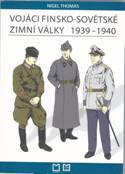 |
Vojáci Finsko-Sovětské Zimní Války 1939-1940
(Soldiers of the Finnish-Soviet Winter War 1939-40)
(Montanex Press, Ostrava, Czech Republic)
ISBN 80-7225-224-0
First Edition 2006
History of the Finnish Soviet Winter War with a detailed survey of the uniforms and insignia of the Finnish Armed Forces and Civic Guard and the Soviet Armed Forces and NKVD. One map, five coloured plates of uniforms, twelve plates of rank ionsignia and branch-badges. Text in Czech.
Out of Print but may be available from Abebooks.com or similar websites. |
 |
The Royal Hungarian Army in World War II
(Men-at-Arms 449)
ISBN 978-1-84603-324-7
First Edition 2008
Collaborated with László Pál Szabó.
A comprehensive history of the Royal Hungarian Army, Navy, Air Force and Gendarmerie 1939-1945, concentrating on the war on the Eastern Front with in-depth uniform chronology as well as branch distinctions. The eight colour-plates are by Darko Pavlovic and the rank insignia plates of Royal Hungarian Army collar, cuff, cap sleeve rank insignia are by László Pál Szabó.
A map and Order of Battle of Royal Hungarian Army are also included.
A detailed reference on a neglected player in World War II.
Buy the book | Buy the E-book |
 |
World War II Soviet Armed Forces (1) 1939-41.
(Men-at-Arms 464)
ISBN 978-1-84908-400-0
First Edition 2010
A history of the M1935 uniforms and organization of the Red Army, Navy, Air Force, Marines, Paratroopers and NKVD security and frontier troops 1939-41, covering the Far-Eastern campaigns against the Japanese, the occupation of Eastern Poland, the Winter War with Finland and the Axis invasion of the Soviet Union up to December 1941. Included are detailed charts of orders of dress, branch distinctions and ranks as well as eight colour-plates by Darko Pavlovic.
Buy the book | Buy the E-book |
 |
World War II Soviet Armed Forces (2) 1942-43
(Men-at-Arms 468)
ISBN 978-1-84908-420-8
First Edition 2011
This volume covers the M1940 uniforms and M1942 organization of the Red Army, Navy, Air Force, Marines, Paratroopers and NKVD security and frontier troops in World War II in the period January 1942 - December 1943, as the Soviet forces halted the German advance and took the counteroffensive. There are detailed charts of the branch distinctions and ranks as well as eight colour-plates by Darko Pavlovic.
Buy the book |
 |
World War II Soviet Armed Forces (3) 1944-45
(Men-at-Arms 469)
ISBN 9781849086349
First Edition 2012
A history of the M1943 uniforms and organization of the Red Army, Navy, Air Force, Marines, Paratroopers and NKVD security and frontier troops 1944-45, covering the advance into Eastern Europe and the defeat of Germany and the Manchurian campaign against the Japanese. Included are detailed charts of orders of dress, branch distinctions and ranks as well as eight colour-plates by Darko Pavlovic.
Buy the book | Buy the E-book |
 |
Hitlers Blitzkrieg Enemies 1940
(Men-at-Arms 493)
ISBN 9781782005964
First Edition 2014
This volume will cover for the first time in detail in English the armed forces of Denmark, Norway, Luxembourg, Netherlands and Belgium in the unsuccessful defence of their countries against Nazi Germany in April - June 1940. The combat record of these countries will be supported by detailed information of their organization, uniforms and insignia as well as charts of rank insignia and orders of battle and eight colour-plates. This will be a reference full of information difficult to find elsewhere.
Buy the book | Buy the E-book |
 |
Hitler's Russian and Cossack Allies 1941-45
(Men-at-Arms 503)
ISBN 978-1-4728-0687-1
First Edition 2015
In August 1941, two months after Hitler's invasion of the Soviet Union large numbers of Red Army soldiers began volunteering to fight for Hitler against Stalin's Soviet Union, serving in Russia, Belarus and Ukraine, later in France, Italy and Croatia and even the Channel Islands. This book examines the organization, history, uniforms and insignia of the Russian and Cossack units, as well as the motives and often tragic fate of these soldiers.There are charts and eight colour-plates of uniforms, providing a fresh perspective on an aspect of the Second World War often neglected in general histories.
Buy the book | Buy the E-book |
 |
World War II German Motorized Infantry & Panzergrenadiers (Elite)
ISBN 978-1-4728-1943-7
First Edition 2017
In World War II Germany's doctrine of mobile warfare dominated the battlefield. By trial and error, the Germans were the first to correctly combine the strength in tanks and in mobile infantry and artillery. This integration of mobile units, equipment and tactics underpinned Germany's successes in the first half of the war. As the war dragged on, the Allies sought to copy German tactics but German armies remained supreme in this type of warfare until their losses had seriously degraded their capabilities.
This study traces the development of the different types of unit that came together in the Panzergrenadier branch from the inter-war years through World War II. Using colour plates to display the changes in uniform, equipment and insignia in all theatres of operations throughout the conflict, this is a complete account of Hitler's elite armoured infantry. (Amazon.co.uk)
Buy the book | Buy the E-book |
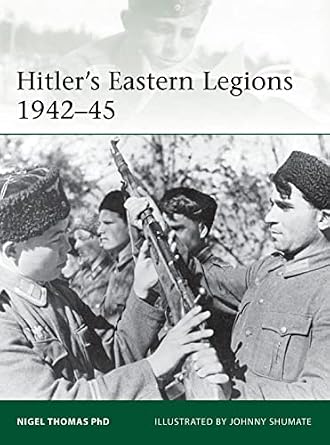 |
Hitler's Eastern Legions 1942-45 (Elite)
ISBN 978-1472839541
First Edition 2020
Between 1941-45, the Germans recruited around 175,000 men from a number of minorities in the USSR, distinguishing between 'Turkomans' (predominantly Muslims) and 'Caucasians' (predominantly Orthodox Christians). Of these, many formed rear-area auxiliary units, but at least 55,000 were combat troops. The first recruits formed two battalions in the 444th Security Division raised as early as November 1941; during 1942-43 seven legions were formed, each of several battalions, eventually totalling some 53 battalions (equivalent to about 6 full divisions). However, with one exception (162nd Turkoman Division), they were not deployed as whole formations; after training in Poland, individual battalions were posted to fill out German regiments in the front lines, at first in Army Group South but later in all three Army Groups fighting on the Eastern Front. Units were also sent to Yugoslavia, Italy and the Western Front.
This fully illustrated history of the Eastern legions details the organization, battle orders, combat history, uniforms and insignia of these unique units, combining contemporary photographs and full-colour illustrations with expert research from military historian Dr Nigel Thomas. (Amazon.co.uk)
Buy the book | Buy the E-book | Blog Post |
 |
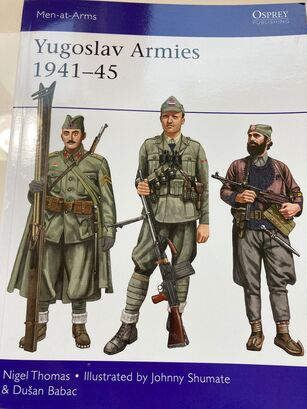
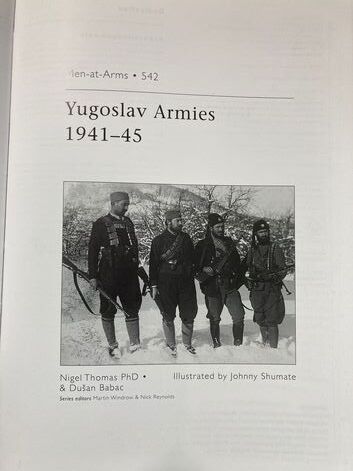
Yugoslav Armies 1941–45 (Men-at-Arms)
ISBN 978-1472842039
First Edition 2022 - Published 20 January 2022
Collaborated with Dusan Babac (Author), Johnny Shumate (Illustrator)
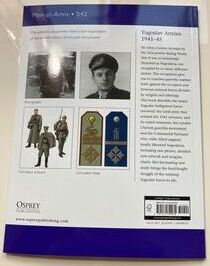
In March 1941, an anti-German coup in the Kingdom of Yugoslavia prompted Hitler to order an invasion using allied Italian, Hungarian, Bulgarian and Romanian forces. Operation Marita was an invasion of Yugoslavia and simultaneously Greece. At the same time, the constituent region of Croatia broke away from Yugoslavia and joined the Axis powers. Royal Yugoslav armed forces, despite advancing against the Italians in Albania were forced to surrender after 11 days' fighting and some 1,000 soldiers, airmen and sailors escaped to British-occupied Egypt to form Free Yugoslav units. From there, guerrilla resistance to the Axis occupiers broke out and continued with increasing strength until the end of the war under Mihailovic's royalist 'Chetniks' and Tito's Communist 'Partisans' (both supported by Britain). However, hostilities between the two movements eventually led to the Chetniks entering into local agreements with Italian occupation forces and Britain switching its support entirely to the Partisans. The advance of the Red Army increased Partisan strength and, during 1944-45, they created what could be described as a lightly equipped conventional army.
Using meticulously-drawn illustrations of different insignia, uniforms and equipment from each faction to bring the conflict alive, this volume describes, in detail, both the political and military implications of the war and how it was fought, setting the scene for the subsequent rise of Tito to power within Yugoslavia. (Amazon.co.uk)
Buy the book | Buy the E-book
|
|
 |
Czechoslovak Armies 1939-45 (Men-at-Arms)
ISBN 978-1472856852
First Edition 2024 - Published 18 January 2024
Collaborated with Johnny Shumate (Illustrator)
Featuring rare photos, detailed colour illustrations and insignia tables, this study explores the contribution made by Czech and Slovak troops fighting alongside Allied forces during World War II.
Following the Anglo-French failure at the Munich Conference in March 1938 to prevent a Nazi take-over of Bohemia-Moravia (modern Czech Republic/Czechia), many frustrated Czech and Slovak soldiers sided with Allied forces and fought alongside their armies - first in Poland, then in France, and finally from Britain.
Using depictions of relevant uniforms and equipment plus photos of the troops in action, military uniformology expert Nigel Thomas explains how the Czech Army was organized and how it fought alongside Allied forces in the Middle East and at Normandy. He describes the involvement of free Czech agents operating from Britain in Operation Anthropoid, the assassination of Nazi governor Reinhard Heydrich in occupied Bohemia-Moravia, and the part Czech soldiers played in mutinies in both Italy and Prague against German occupation which ultimately helped to secure a final Allied victory. (Amazon.co.uk)
Buy the book | Buy the E-book
|
 |
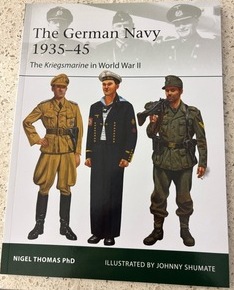
The German Navy 1935-45: The Kriegsmarine in World War II
260 (Elite)
ISBN 978-1472863126
First Edition 2025 - Published 27 February 2025
Collaborated with Johnny Shumate (Illustrator)
An illustrated study of the uniforms and personal equipment worn by the personnel of the Kriegsmarine, the German Navy of the Third Reich, from 1935-45.
Founded in defiance of the Treaty of Versailles, the Kriegsmarine was established in 1935 and reached a peak strength of more than 800,000 personnel in 1944. Its original aim of amassing a surface fleet on parity with Great Britain’s Royal Navy shifted with the outbreak of World War II, after which focus moved to submarine warfare, with the Kriegsmarine’s U-boats exacting a heavy toll on Allied shipping across the globe. Meanwhile, several of its formidable capital ships – notably the Graf Spee, Bismarck, Tirpitz, Scharnhorst and Gneisenau – saw widespread action as Nazi Germany strove to defeat the Allies at sea.
In this new study, Nigel Thomas examines the evolving organization, uniforms and equipment used by the Kriegsmarine during its ten-year existence, spanning its pre-war beginnings, the invasion of Norway in 1940, and through to the deployment of Kriegsmarine personnel as grounds troops from 1943–45. The different gear worn by its various branches of service is described in detail and illustrated with newly commissioned colour artwork and an array of specially selected photographs. (Amazon.co.uk)
Buy the book | Buy the E-book
|
|